
The European Institute for Brain Research (EIBR) is a non-profit research institute created with the aim to promote scientific research in the field of neuroscience, social sciences as they relate to neuroscience, and philosophical and bioethical questions relating to neuroscience.
Our main goal is big: we want to find ways to keep whole brains from humans and non-human animals intact after they die. We want to do this because we want to see how the tiny parts of the brain are arranged and connected. These tiny parts are called cells, and they are the building blocks of the brain. There are two main types of cells in the brain: neurons and glial cells. Neurons are cells that produce electrical impulses. Glial cells are like helpers that support the neurons. The human brain has about 80-90 billion of each type of cell. So in total, that’s more than twenty times the number of people on Earth! Neurons connect to each other at special places called synapses. Each neuron has about 1000 synapses on average. These connections allow neurons to form neural circuits and elaborate systems.
We want to develop a way to preserve the three-dimensional structure of all the brain cells, the connections between them, and the molecules in each tiny part. This will help us to make a computer model of the brain and figure out how it does amazing things like thinking, feeling, and remembering. Brain cells have different parts: the cell bodies, or somas, which is like the control center; the dendrites, which are like antennas that receive signals; the axons, which are like wires that send signals; and the synapses, which are like junctions where axons and dendrites meet (see figure below).
We will need to know what kind of molecules are in these parts, especially the synapses, because they are important for storing memories. We think that memories are made by making the connections between brain cells stronger.
The best way to deliver the chemicals necessary to preserve the brain cells in the whole brain is to use the blood vessels. This is because the smallest blood vessels are very close to the brain cells, so the chemicals can reach them quickly. However, these blood vessels get blocked if the brain does not get enough oxygen. This is why we need to act very fast to preserve the brain. In our experiments with animals we found out that we have to do this in less than 15 minutes after the heart stops.
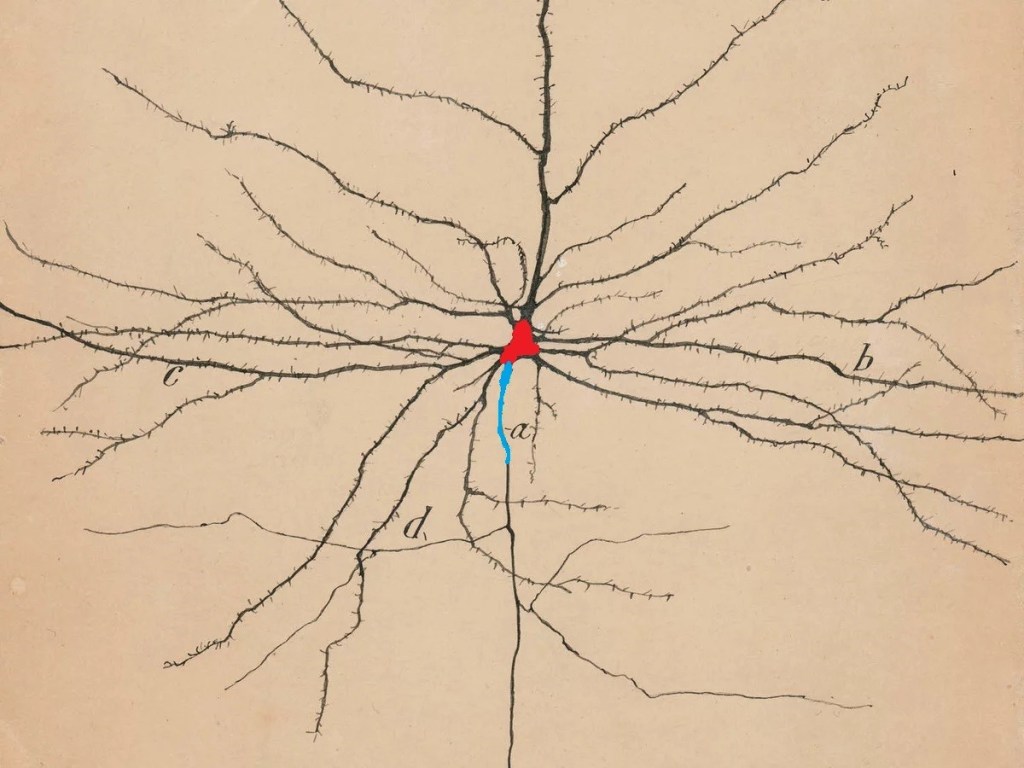
In this picture of a neuron, originally drawn by Ramon y Cajal, we colored the cell body red and the beginning of the axon blue. The other ‘branches’ are dendrites, and the little knobs on them is were the synapses are. Note that the picture shows only one neuron, which in the tissue would be densely surrounded by the axons from the connecting neurons and neighbouring cells (other neurons, glia).
 EIBR
EIBR 